




You can know you’re good at what you do and still have that moment at a listing appointment where your value feels harder to explain than it should.
Maybe you’re sitting at the seller’s kitchen table. Maybe you’re walking through their home, noticing the updates, thinking about the comps, already mentally sorting through how you’d position the property. Maybe you can tell they like you. The conversation feels warm. They’re nodding. They’re asking good questions.
And still, somewhere in the middle of the appointment, you feel yourself trying to pull all the right words together.
You know the marketing you do.
You know the pricing strategy matters.
You know the behind-the-scenes work it takes to get a home ready, launched, shown, negotiated, and closed.
You know you can help them.
But knowing your value and clearly communicating your value are not always the same thing.
That’s where a lot of good agents get stuck.
Not because they are unprepared. Not because they lack experience. Not because they don’t care deeply about their clients.
But because when your process lives mostly in your head, it can be hard to explain it in a way that feels clear, organized, and easy for the seller to trust in the moment.
And that is exactly why your listing presentation matters.
Not just because it looks professional.
Not just because it gives you something to bring to the appointment.
But because a strong listing presentation helps sellers understand how you think, how you work, and what the actual plan is if they hire you.
A seller can like you and still leave the appointment unsure.
That is the part agents do not always talk about.
They can think you are kind. They can feel like you know the market. They can believe you are capable. But if they do not clearly understand your plan, they may still hesitate.
Because sellers are not only deciding if they like you.
They are trying to decide if they trust you with one of their biggest financial decisions.
So your listing presentation needs to do more than say, “I’m a great agent.”
It needs to help the seller feel:
I understand what is happening in the market.
I understand why pricing matters.
I understand what will happen before my home goes live.
I understand how my home will be marketed.
I understand how this agent will lead me after the listing is active.
That is where confidence comes from.
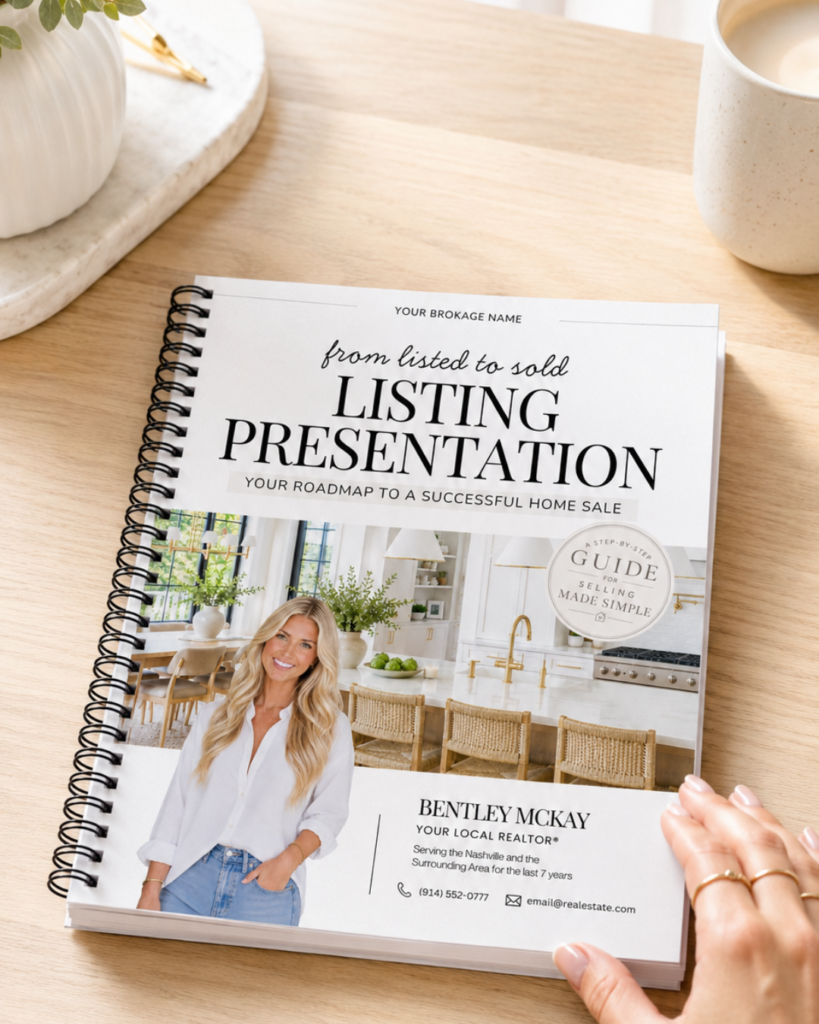
So if you’re wondering what to include in your listing presentation, start here.
1. Your read on the current market
Before a seller can trust your pricing, marketing, or strategy, they need to feel like you understand what is happening in the market right now.
Not in a generic “the market is always changing” way.
They need to hear how you are thinking about buyer behavior, competition, price sensitivity, days on market, inventory, interest rates, and what sellers in their area are actually experiencing.
This does not mean your listing presentation needs to be overloaded with charts or statistics.
It means the seller needs to feel like you are not guessing.
There is a big difference between saying, “The market is still strong,” and saying something more specific like, “Buyers are still active, but they are being more selective. The homes that are priced well and show well are still getting attention, while homes that miss the mark are sitting longer and needing adjustments.”
That kind of language helps the seller understand the environment they are stepping into.
It also positions you as someone who is paying attention, not just repeating the same market update every other agent is giving.
Your listing presentation should make room for your market perspective.
What are buyers responding to right now?
What is causing homes to sit?
What are sellers misunderstanding?
Where does this home fit compared to the competition?
The goal is not to overwhelm them with data.
The goal is to help them feel like you have a grounded read on what is happening and how that affects their sale.
Because if the seller does not believe you understand the market, they will have a harder time trusting the rest of your advice.
2. Your pricing strategy
Pricing is one of the most important parts of a listing appointment, but it is also one of the easiest places for sellers to misunderstand your value.
Most sellers know pricing matters.
But many do not understand how much strategy actually goes into it.
They may think pricing is simply looking at a few nearby homes, choosing the highest number that feels reasonable, and seeing what happens.
But you know it is more layered than that.
You are looking at comparable sales, active competition, condition, location, buyer demand, price brackets, timing, online search behavior, and what the market has already rejected.
You are thinking about how the home will appear next to other options buyers are seeing.
You are thinking about whether the price will create interest or create resistance.
You are thinking about what happens if the home launches too high and has to chase the market later.
That is valuable. But if you do not explain it clearly, the seller may only hear the final number.
Your listing presentation should help them understand how you think through pricing, not just what price you recommend.
This is where you can show them that pricing is not about being optimistic or pessimistic.
It is about positioning.
A strong pricing section should help the seller understand questions like:
What are buyers comparing this home to?
What price range will this home show up in online?
What happens if we price ahead of the market?
What happens if we price behind it?
How will we know if the market is responding?
This is also where you can gently prepare sellers for the reality that the market gives feedback.
Sometimes that feedback is strong showing activity.
Sometimes it is silence.
Sometimes it is interest without offers.
Sometimes it is an offer that tells you what buyers are willing to do.
When sellers understand your pricing strategy before the home goes live, the whole process feels less emotional later.
Not because pricing becomes easy.
But because they understand there is a plan behind it.
3. What happens before the home goes live
This is one of the most overlooked parts of a listing presentation because so much of the work feels obvious to agents.
But it is not obvious to sellers.
A lot of sellers do not realize how much happens before their home ever hits the market.
They may think listing a home means signing paperwork, taking photos, putting it on the MLS, and waiting for showings.
But you know the prep work matters.
This is where your behind-the-scenes value really starts.
Your listing presentation should explain what happens before launch, because this is where sellers begin to see that your job is not simply to “put the home online.”
You are helping them prepare the home to compete.
That might include staging guidance, repair conversations, decluttering recommendations, cleaning details, photography prep, vendor coordination, copywriting, MLS positioning, showing instructions, launch timing, and making sure the home is presented in a way that supports the price.
This does not have to feel complicated.
It just needs to feel clear.
The seller should be able to look at your process and think, “Okay, this person knows how to get a home ready.”
That matters because a rushed listing can cost a seller attention.
And in real estate, attention matters.
The way a home shows online matters.
The first impression matters.
The launch timing matters.
The details in the listing matter.
The way the home is positioned against the competition matters.
When you walk sellers through what happens before the home goes live, you are helping them understand that preparation is part of the strategy.
Not just a checklist.
Not just busywork.
Part of the plan.
4. How your marketing plan actually works
Every agent says they market listings.
That is why this section of your listing presentation needs to go deeper than “professional photos,” “social media,” and “online exposure.”
Those things are fine to include, but sellers need to understand what your marketing is actually designed to do.
Because from the seller’s perspective, marketing can feel vague.
They may not know the difference between an agent who has a thoughtful launch plan and an agent who posts the home once and hopes the MLS does the rest.
Your listing presentation should help them understand how your marketing creates attention, builds interest, and supports buyer confidence.
This is where you can explain the purpose behind the pieces.
Photography is not just about having pretty pictures. It is about helping buyers feel pulled into the home before they ever schedule a showing.
Listing copy is not just a description. It is positioning.
Social media is not just posting for the sake of posting. It is another way to create visibility and get the home in front of people who may know the right buyer.
Email marketing, agent-to-agent outreach, open houses, digital ads, video, local promotion, and listing launch strategy all need to connect back to the bigger goal: getting the right buyers to pay attention and take the next step.
This is where a lot of agents accidentally undersell themselves.
They do more than they explain.
They have a stronger marketing plan than the seller realizes.
They know how to create momentum, but they describe it in a way that sounds like every other agent.
Your listing presentation should help you make the marketing feel specific.
Not louder.
Not more complicated.
Just clearer.
The seller should walk away understanding not only what you will do, but why it matters.
5. How you lead after launch
A lot of listing presentations spend most of the time getting to the launch.
The prep.
The pricing.
The marketing.
The photos.
The MLS.
The big moment when the home goes live.
But sellers also need to know what happens after that.
This is one of the biggest places you can build confidence.
Because launching the listing is not the finish line.
It is the beginning of the market response.
What happens if showings are strong?
What happens if showing activity is slower than expected?
What happens if buyers are interested but not writing offers?
What happens if feedback points to price, condition, layout, location, or competition?
What happens if an offer comes in quickly?
What happens if the seller feels anxious three days in?
This is where your communication style, leadership, and experience matter.
Your listing presentation should explain how you guide sellers once the home is active.
How often will you communicate?
How will you share feedback?
How will you review showing activity?
How will you talk through adjustments if needed?
How will you handle offers?
How will you help them make decisions without feeling rushed or left in the dark?
This is the part that helps sellers feel like they will not be abandoned after the sign goes in the yard.
And honestly, that matters.
Because a lot of seller anxiety does not come from the listing appointment itself.
It comes from the unknowns after.
A clear listing presentation helps the seller see that you do not just have a plan for getting the home listed.
You have a plan for leading them through the entire process.
Your listing presentation should make your value easier to understand
The goal of a listing presentation is not to prove that you are impressive.
It is to make your value easier to understand.
There is a difference.
When your presentation is only about you, your awards, your brokerage, and your marketing pieces, the seller may still be left trying to connect the dots.
But when your presentation clearly walks through your market perspective, pricing strategy, prep process, marketing plan, and communication after launch, the appointment starts to feel different.
It feels less like a pitch.
More like, “Here is the plan.”
And that is what sellers need.
They need to understand what you see, what you recommend, what you will do, and how you will guide them if the market responds differently than expected.
That kind of clarity builds trust.
It also helps you as the agent.
Because you are no longer trying to remember every single thing you wanted to say.
You are not scrambling for the right words when pricing questions come up.
You are not hoping the seller understands how much work happens behind the scenes.
You have a structure that helps you lead the conversation.
And that is the part that can change how you show up at the appointment.
Not because a template does the work for you.
But because a strong listing presentation gives your work a clear place to live.
A quick way to audit your current listing presentation
Before your next seller appointment, look through your current presentation and ask yourself this:
Would a seller understand how I think, or just what I do?
That question alone can show you what is missing.
If your presentation says you offer professional photography, does it also explain why the way a home is presented online impacts buyer interest?
If your presentation includes a pricing page, does it clearly explain your strategy, or does it just show the recommended price?
If your presentation lists marketing channels, does it explain how those channels work together to create attention?
If your presentation talks about your experience, does it connect that experience back to how you will guide this specific seller?
If your presentation looks beautiful but does not help the seller feel more confident in the plan, it may not be doing enough.
Pretty is not the whole goal.
Confidence is.
The best feedback on a listing presentation is not just, “This looks nice.”
It is:
“This helped me feel prepared.”
“This made the conversation easier.”
“This helped the seller understand my value.”
“This gave me confidence walking into the appointment.”
That is what a good listing presentation should do.
The updated Listing Presentation Template is inside Agent Site Shop
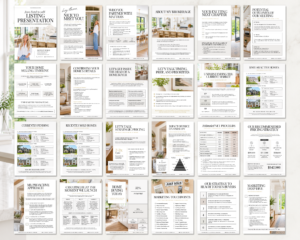
This is exactly why we updated the Listing Presentation Template inside the Agent Site Shop membership.
Not just to make it look polished.
Not just to give you more pages to customize.
But to help you walk into seller appointments with a clearer way to explain your value, organize your process, and guide the conversation.
The updated Listing Presentation Template is now available inside the Agent Site Shop template vault for members.
And when you join, you do not just get this one template.
You also get access to the full template vault, plus monthly real estate marketing content created for agents who want to show up consistently, market themselves well, and stop recreating everything from scratch every time they need something.
So if your current listing presentation does not clearly walk sellers through your pricing strategy, prep process, marketing plan, communication style, and what it actually looks like to work with you, this is a good time to update it.
Because your value is already there.
Your listing presentation should help sellers see it.
Join the Agent Site Shop membership to get access to the updated Listing Presentation Template inside the vault, plus the full library of real estate templates and monthly marketing content made for agents.

+ show Comments
- Hide Comments
add a comment